Artificial intelligence now takes over much of the intellectual work students do: it summarizes information, writes text, solves problems, and structures arguments. When AI does too much, it offloads the thinking needed for learning and building competence.
Bans are unlikely to stop this development. AI will remain part of everyday life. Just as machines make physical work easier, we need to strengthen our intellectual abilities through our own thinking and action.
Schools will therefore need to deliberately promote cognitive fitness, just as they train physical fitness today.
AI must be designed for learning
Simply integrating general-purpose AI into learning is not enough. We need purposeful educational design, including AI learning technologies developed specifically for learning.
These systems should
- support students’ learning processes,
- encourage independent explaining, reasoning, checking, and decision-making,
- recognize and limit unhelpful assistance,
- and make learning processes visible to teachers.
What we want to understand
Our research explores how AI learning technologies should be designed and integrated into teaching so that they support learning rather than undermine it.
We are particularly interested in six questions:
- What educational opportunities do AI learning technologies offer?
- How should these technologies be designed to support learning rather than replace thinking?
- Which teaching settings help ensure that AI is used to support learning?
- Which fundamental foundational skills should learners develop in a world where AI is ubiquitous?
- How will this change the role of teachers?
- How can we bring these findings step by step into teacher education?
AIDu
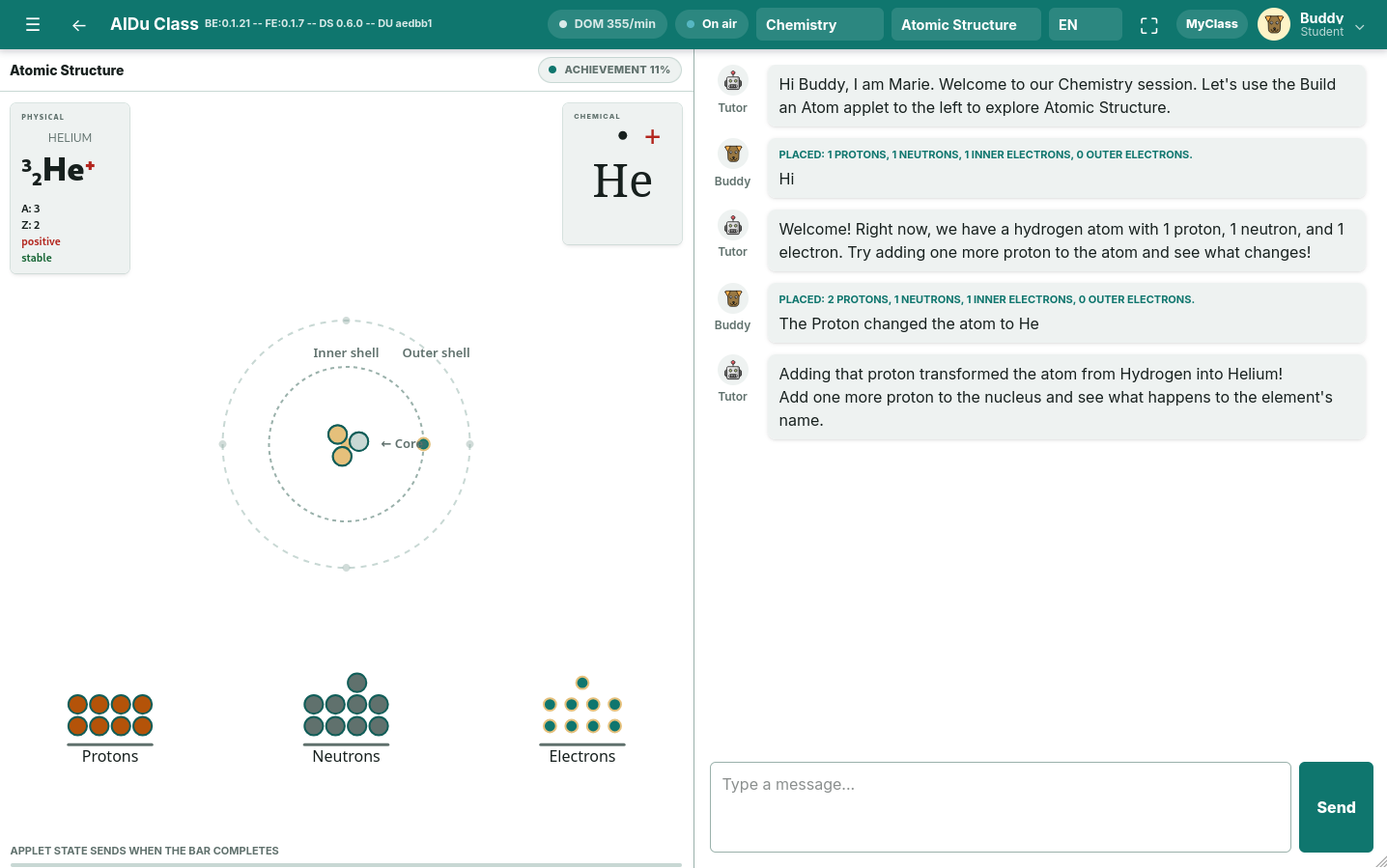
With AIDu, we have built a research platform for developing, testing, and studying educationally designed AI learning technologies.
AIDu combines:
- agent-based AI tutors with carefully defined educational behaviours,
- interactive microworlds for exploratory learning,
- defined learning objectives and teaching scenarios,
- observation and supervision of AI interactions,
- and pre-, post-, and follow-up surveys to study learning processes and progress.
Foundational skills
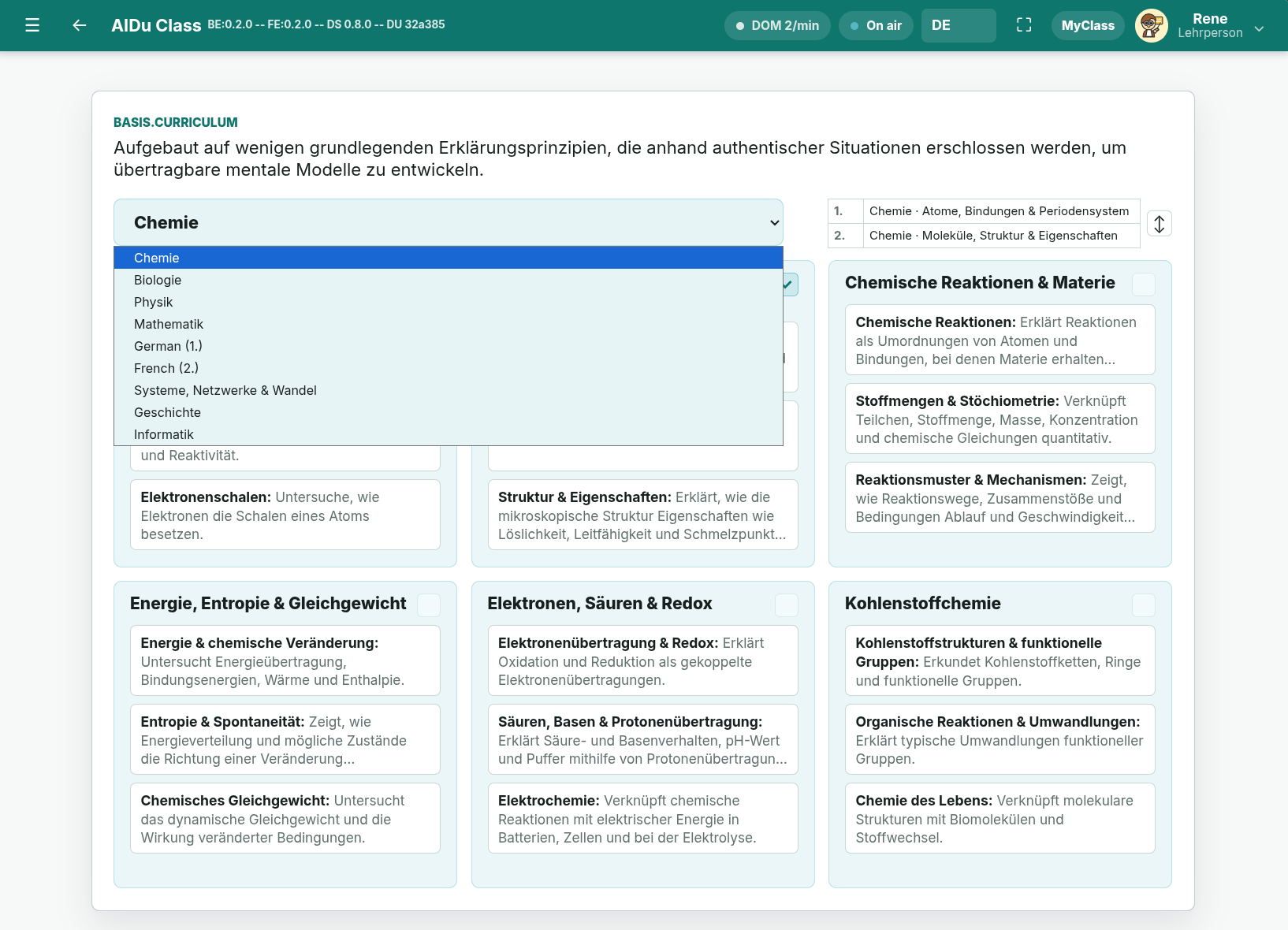
AIDu demonstrates how foundational skills can be developed across subjects. We focus on a basic curriculum built on fundamental explanatory principles that provide a foundation for further learning. Using authentic situations, learners explore these principles with AIDu and develop lasting mental models.
Teaching trials
Would you like to try AIDu with your pupils or students in class or a seminar and take part in our teaching trials?
How it works:
- Register your school: Email wolfgang.spahn@phbern.ch to register your school or university.
- Choose a lesson: Select the lesson and learning objectives for your class.
- Invite your class: After registration, you will receive access to the AIDu platform and can invite your students.
- Run the trial: Students sign in to AIDu anonymously and complete the learning activities.
- Review learning outcomes: After the trial, analyse students’ learning outcomes in the system and provide feedback.
- Share feedback: Tell the AIDu team about your experience.
Register your school for our teaching trials: wolfgang.spahn@phbern.ch
References
Buchner, J., W. Spahn, and M. Eyer. 2026. “AIDu: Epistemisches KI Tutoring Für Ein Selbstgesteuertes Lernen.” SGFB Jahreskonferenz (University of Zurich, Switzerland).
Eyer, M., and W. Spahn. 2025. “Epistemisches KI Tutoring: Für Ein Selbstgesteuertes Lernen in Der Sekundarstufe.” Wie Viel Wissenschaft Braucht Die Lehrpersonenfortbildung (PHSG, Rorschach, Switzerland).
Langenegger, R. 2025. “Lernen Durch KI: Eine Pilotstudie Zum Einsatz Eines ITS Der PHBern Im Informatikunterricht Auf Gymnasialer Stufe.” Master’s thesis, PHBern.
Spahn, W., J. Buchner, and M. Eyer. 2026. “Designing for Epistemic Learning in Secondary Schools.” LELEDIZ (Linz, Austria).
Spahn, W., and M. Eyer. 2025. “AIDu: Epistemisches KI Tutoring Für Ein Selbstgesteuertes Lernen.” Wie Viel Wissenschaft Braucht Die Lehrpersonenfortbildung (PHSG, Rorschach, Switzerland).